Creating Gardens of Loving Kindness
by Linus Dolfini
Bangkok, April 11, 2025
This article is based on an interview with Kanchana Weerakoon conducted at Wongsanit Ashram on March 6, 2025.
The concept of Metta Gardening was established in 2013 in Sri Lanka. One of our Eco-Temple Network members, Kanchana Weerakoon, first came up with the idea. She explains that she was inspired by the community-gardens she saw in Australia. After her family bought a piece of abandoned land, she gave life to her idea and created the very first Metta Garden, restoring he land with healthy soil and revitalizing it by planting specific species, which attract bees and butterflies. For Kanchana it was crucial to create a space for all beings, which is the feature that distinguishes these gardens from other conventional gardening projects. She describes the Metta Gardens as a product of her passion for nature and her Buddhist background.
 People from the surrounding neighborhoods quickly learned about the new concept and were intrigued by this natural garden, which looked different from traditional parks and where the strict no-pesticide policy quickly attracted plenty of different species such as bees, butterflies, and birds. The project was further made accessible for the community by encouraging the people to bring their kitchen waste, which could then be used as fertilizer for the garden. In return, people who brought their “waste” often got some of the garden’s earnings such as fruits and vegetables as gifts.
The word Metta is a Buddhist term which roughly translates to Loving Kindness. A Metta Garden is a “Garden of Loving Kindness”. Such a garden is designed to practice Metta toward all beings, seen and unseen, and it aids humans as well as all other living beings in the environmental struggles they are facing these days. Metta Gardens are easy to create and can help make cities greener, increase biodiversity, combat air pollution, and fight climate change.
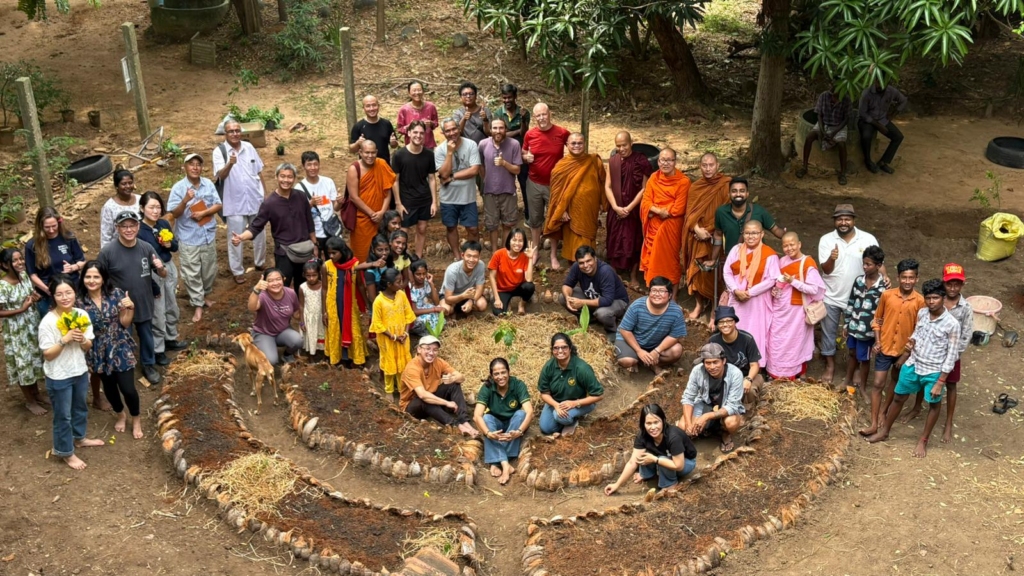
Typically, a Metta Garden is designed as a mandala, which is a sacred geometric form that represents the universe. The beds are organized in a specific fashion, namely in the form of ripple-effect beds. One big round bed is built at the center of the garden while the others are planted around it in the form of half- or quarter-circles with paths between them on which humans can walk without damaging any other beings such as plants and animals. The ripple-effect layout represents the idea of planting a seed physically as well as spiritually. The ripples which are caused by the initial action, spread throughout the surrounding community, and lead to the creation of more Metta Gardens. By planting one seed, the idea is carried further like waves in a pond after a stone is thrown.

A Metta Garden becomes a place where visitors can connect to nature by using their five sensory organs whilst also experiencing the sixth one: Vajiana or consciousness. Appreciating all the fellow beings and connecting to them – even the non-living components such as the earth – is central to the Metta Gardens. Practicing it can help people who live in large cities and feel disconnected from nature. By spending time in Metta Gardens, they can reconnect and become more familiar with nature.
Of course, Metta Gardens need some maintenance otherwise they will be overgrown, and dominant species such as mosquitoes or certain aggressive plants will take over. However, it is crucial to the gardens that no pesticides or herbicides are used, so all the products coming from any of the gardens are one hundred percent organic. The maintenance of the Metta Gardens is a mental and spiritual practice. Doing some physical labor out in a natural environment often has a very relaxing effect on people and helps them to calm their minds and refocus.
The Metta Garden is a beautiful and promising concept since the gardens are so easy to create. Everyone who owns a small piece of land, a backyard or just a balcony can create a small Metta Garden of their own, even if they live in the middle of a large city. And eventually the people who decide to grow a garden will profit from its output. This is important because it shows that Metta Gardens are not a project for the wealthy, in fact they are accessible for a majority of people, which makes them a promising bottom-up approach to create more green areas in cities.

Implementing Metta Gardens in cities has direct advantages for the health and quality of life of the citizens. These days one of the big problems is that many large urban areas are heavily polluted. At the same time, they are getting hotter and hotter, because they store more heat than the surrounding areas. Creating more green areas will improve the air quality and it will help to cool the city down, since green spots will make sure that not all the heat is absorbed by concrete and glass constructions. Furthermore, these gardens create refuges for various species that would otherwise not have any living space in the cities. Hence, the Metta Gardens also help to increase the biodiversity of the neighborhood in which they are located. It has long been known in sustainability research that cities are affected by problems such as heatwaves, pollution and the loss of biodiversity. Metropolitan areas need to be made greener. Metta Gardens give people an opportunity to address these issues themselves without relying on government action. People can simply decide to dedicate their land to this purpose and transform their cities little by little. Metta Gardens can also be adapted to specific cultures, their key concept is universal and does not require a Buddhist background.
There are strong social components to the existing Metta Gardens that are managed by Kanchana and her team. They have become places where youngsters can be introduced to nature. These days children often grow up disconnected from nature. This means that they do not feel comfortable in nature later on because they did not learn how to directly appreciate it and why it is valuable. Out of this disconnect, people develop allergies and nature deficit disorders. For the kids of generation alpha, it is important to be introduced to nature in some form, especially if they live in cities. Kanchana and her team offer programs for children aged five to sixteen to come to the Metta Garden with their parents and enjoy the foods and drinks made from the plants that grow there while experiencing the natural surroundings. Through this Metta Gardens provide concrete practice-oriented approaches at educating youngsters and introducing and connecting them to nature.
Metta Gardens are also a space where people can find relaxation. Eco-therapy sessions are being held there a comforting surrounding where people can feel at ease mentally and physically. Kanchana explains that sometimes these sessions include people getting physically involved and that working in nature, conducting a hands on task is one of the fastest ways to achieve a feeling of peace and happiness. In fact most of those who take care of the gardens are not fully employed, they are volunteers who come occasionally to nurse the existing gardens. Through this work, they benefit their own wellbeing while supplying the surrounding community with the gardens’ surplus.
 Throughout the last twelve years, the concept has spread. The second Metta Garden was established in 2015 after a woman approached Kanchana to ask if she would like to buy her land and transform it into another Metta Garden. She explained that she did not want to sell her land to anyone else, but that she was in love with the Metta Garden idea. After that people started to learn more about Metta Gardens through articles and posts on the internet. Kanchana and her ECO-V organization – ECO Friendly Volunteers – got a lot of requests from people who wanted to create Metta Gardens on their own land. Therefore, Kanchana came up with a new approach. Her team would maintain the gardens in exchange for a donation from interested parties. Eco-V is not a donor based organization and needs some additional income to do their work effectively. In addition, the people who were interested in planting a Metta Garden were made aware that the garden will not only benefit and provide for them. Metta Gardens are created to benefit a community and not only individual families.
Nowadays, there are a number of Metta Gardens in different cities and countries. In Colombo alone, there are currently nine Metta Gardens. Another one is located in New Delhi on the premises of the Buddhist temple of the Mahabodhi Society. Here you find the article about said project. During the Eco-Temple workshop in Auroville, India in late November of 2024, another one was created at a local school in Nadukuppam Village under the leadership of Kanchana and Dr. Geetha. A detailed report on the workshop can be read here. Furthermore, there are now plans to establish Metta Gardens in Japan and Hawaii with the help of Kanchana and other members of the Eco-Temple Network.
If you are interested in learning more about Metta Gardening you may access this feature article written by Kanchana herself.